
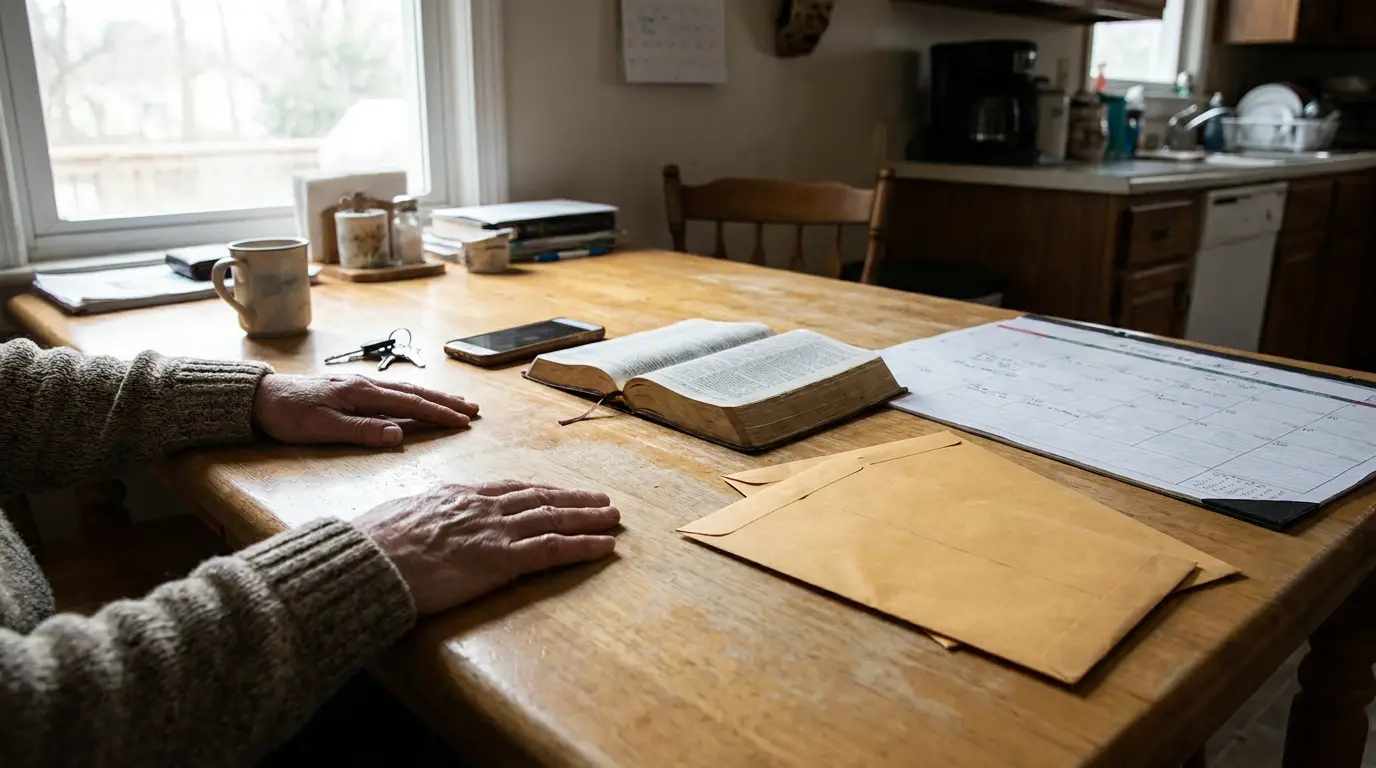

Every day is full of decisions.
Some are small and ordinary. What should I focus on today? How should I respond to this message? Should I say yes or no? How should I spend my time?
Others feel much heavier. Should I take this job? Should I move? Should I continue this relationship? Should I start over? Should I speak up? Should I wait? Should I take a risk? Should I let something go?
Decisions can reveal what is really first in our hearts.
If you need the broader heart posture first, what it means to seek God first explains why God's rule comes before our plans. When decisions are tangled with money, seeking God first with your money helps you bring financial motives into the light. If busyness is pressuring you to rush, seeking God first when life is busy can help you pause before choosing.
When we are unsure, it is easy to seek comfort first, control first, approval first, money first, speed first, or the safest-looking outcome first. We may pray, but still secretly hope God will simply confirm what we already want.
But Jesus calls us to something deeper.
He says, “Seek first the Kingdom of God and His righteousness.”
That includes our decisions.
Seeking God first in your decisions means bringing your choices under the lordship of Jesus. It means asking not only, “What do I want?” or “What will benefit me?” but “Lord, what honors You?”
It is not about fearfully trying to decode every detail of life. It is not about waiting for a sign before making any choice. It is not about becoming paralyzed because you are afraid to miss God.
It is about walking with the Father in trust, wisdom, obedience, and surrender.
God does not merely want to be consulted after we have made our plans. He wants to be first in the way we desire, think, choose, and obey.
What It Means to Seek God First in Your Decisions
To seek God first in your decisions means to place His will, His Word, His Kingdom, and His righteousness above every other desire.
It means Jesus is not just one voice among many. He is Lord.
His way matters more than convenience.
His truth matters more than feelings.
His approval matters more than people’s approval.
His timing matters more than impatience.
His righteousness matters more than personal gain.
This does not mean every decision will be easy. Sometimes obedience is clear but costly. Sometimes wisdom requires patience. Sometimes the right step is not the most comfortable step.
Seeking God first does not always remove tension, but it gives the heart a higher foundation.
Instead of asking, “How do I get the outcome I want?” we begin to ask, “How can I be faithful to God here?”
That question changes everything.
A God-first decision is not always the decision that looks most successful on the outside. It is the decision made with a surrendered heart before the Lord.
Begin by Surrendering the Outcome
One of the hardest parts of seeking God in a decision is surrendering the outcome.
Often, we come to God already attached to what we want. We may ask Him for guidance, but deep inside we are hoping He will agree with our preference.
This is very human.
We want the job to work out.
We want the relationship to be right.
We want the door to open.
We want the risk to pay off.
We want the answer to come quickly.
But seeking God first begins with an open-handed heart.
“Father, I want this, but I want Your will more.”
That kind of prayer is not always easy. It may feel like letting go of control. It may expose fear, disappointment, or hidden attachments. But it is also the place where real trust begins.
Surrender does not mean you stop caring. It means you stop making your preferred outcome the highest authority.
Jesus Himself showed us surrender in the garden of Gethsemane when He prayed, “Not as I will, but as You will.” His obedience was not shallow. It was costly, honest, and fully yielded to the Father.
When we surrender the outcome, we are saying, “Lord, I trust Your wisdom more than my understanding. I trust Your love more than my fear. I trust Your will more than my desire to control the result.”
That is where God-first decision-making begins.
Bring the Decision Into Prayer
Prayer is not a last resort after we have overthought everything.
Prayer is where we bring our whole heart before God.
When you are facing a decision, talk to the Father honestly. Tell Him what you desire. Tell Him what you fear. Tell Him what feels confusing. Tell Him where you feel pressure.
You do not need perfect words.
You can pray simply:
“Father, I need wisdom.”
“Jesus, I do not want to choose from fear.”
“Lord, show me what honors You.”
“Holy Spirit, help me recognize what is from You and what is only my own striving.”
“Father, close what is not from You and give me peace to obey what is.”
Prayer does not always mean you will immediately hear a clear answer. Sometimes God gives direction quickly. Sometimes He gives peace. Sometimes He reveals a motive. Sometimes He brings Scripture to mind. Sometimes He uses counsel. Sometimes He simply leads you one step at a time.
The purpose of prayer is not only to get an answer. It is to stay near the One who leads.
When you bring a decision into prayer, you are reminding your soul that you do not have to carry it alone.
Let Scripture Shape the Decision
God will never lead you in a way that contradicts His Word.
This is one of the most important truths in making decisions.
Sometimes people say they are “following peace” or “following their heart,” but the choice they are considering clearly goes against Scripture. That is not the guidance of God. The Holy Spirit does not lead us away from the truth He inspired.
Seeking God first means allowing Scripture to correct, guide, and shape our choices.
Ask questions like:
Does this decision honor God?
Does it require compromise?
Does it lead me toward obedience or away from it?
Does it reflect love, truth, humility, purity, justice, faithfulness, and wisdom?
Does it help me seek God’s Kingdom, or does it feed pride, fear, greed, bitterness, or selfish ambition?
Some decisions are already answered by Scripture. We do not need to pray about whether to lie, cheat, take revenge, pursue sin, or knowingly disobey God.
Other decisions are not directly named in the Bible, such as which job to take, where to live, or what opportunity to pursue. But even then, Scripture gives wisdom for the heart behind the decision.
God’s Word may not give you the exact address, company name, or timeline. But it will shape the kind of person you are becoming as you choose.
That matters deeply to God.
Ask God to Reveal Your Motives
Decisions are not only about options. They are also about motives.
Two people can make the same outward choice for very different reasons. One may choose from faith, the other from fear. One may say yes from love, the other from people-pleasing. One may work hard to honor God, the other to prove their worth.
This is why seeking God first includes asking Him to search the heart.
“Lord, why do I really want this?”
“What am I afraid of losing?”
“Am I seeking Your will, or am I seeking control?”
“Am I trying to obey You, or am I trying to impress people?”
“Am I being led by love, wisdom, and truth — or by fear, pride, greed, or comparison?”
These questions can be uncomfortable, but they are freeing.
God does not reveal our motives to shame us. He reveals them to heal us, purify us, and lead us into truth.
Sometimes we discover that the decision itself is not the deepest issue. The deeper issue is what we are trusting.
We may be trusting money to make us secure.
We may be trusting people’s approval to make us feel valuable.
We may be trusting control to make us feel safe.
We may be trusting speed because waiting feels painful.
When God reveals these things, He is inviting us back to Himself.
A heart that wants God first must be willing to let Him examine not only the choice, but the desire behind the choice.
Seek Wisdom, Not Just a Sign
Many believers want a sign when they are making decisions.
Sometimes God does confirm things in personal and meaningful ways. He is able to open doors, close doors, bring timely encouragement, or make a path clear.
But Scripture calls us again and again to wisdom.
Wisdom is not less spiritual than a sign. Wisdom is one of the ways God leads His people.
Seeking God first means asking for wisdom and being willing to receive it.
Wisdom considers truth.
Wisdom pays attention to character.
Wisdom listens to godly counsel.
Wisdom counts the cost.
Wisdom does not rush because of pressure.
Wisdom does not ignore warning signs because desire is strong.
Wisdom does not call every open door a command from God.
Wisdom does not confuse peace with comfort or discomfort with disobedience.
James 1:5 says that if anyone lacks wisdom, they should ask God, who gives generously.
That is a beautiful promise.
When you do not know what to do, you can ask the Father for wisdom. You can trust that He is not annoyed by your need. He is generous with His children.
Sometimes the wisest decision will feel exciting. Sometimes it will feel costly. Sometimes it will be slow. Sometimes it will require waiting until you can see more clearly.
Do not despise wisdom because you were hoping for something more dramatic.
The guidance of God is often quieter, deeper, and more faithful than the signs we imagine.
Listen to Godly Counsel
God often uses wise people to help us see clearly.
When you are emotionally attached to a decision, it can be hard to recognize what is really happening. Desire can make us ignore red flags. Fear can make us avoid good steps. Pressure can make us rush.
This is why godly counsel matters.
A mature believer, pastor, mentor, parent, trusted friend, or wise Christian leader may help you see what you are missing.
But not all counsel is equal.
Seek counsel from people who love Jesus, respect Scripture, tell the truth, and care more about your obedience to God than simply affirming what you want.
Good counsel will not replace your responsibility to seek God. But it can help confirm, correct, warn, or clarify.
When listening to counsel, pay attention to humility. A surrendered heart does not only look for people who agree. It is willing to be challenged.
Sometimes God uses another person to ask the question we have been avoiding.
Sometimes He uses counsel to slow us down.
Sometimes He uses counsel to encourage us to move forward in faith.
Sometimes He uses counsel to expose a danger we could not see.
Seeking God first means we are not too proud to receive wisdom through His people.
Pay Attention to Peace, But Do Not Worship Feelings
Peace can be part of God’s guidance, but feelings should not become the final authority.
This is important because emotions can be complicated.
Sometimes we feel peace because we are obeying God.
Sometimes we feel peace because we are choosing what is familiar and comfortable.
Sometimes we feel uneasy because something is wrong.
Sometimes we feel uneasy because obedience requires courage.
So yes, pay attention to peace. But do not worship your feelings.
Let peace be considered together with Scripture, prayer, wisdom, counsel, motives, and obedience.
A decision that violates God’s Word is not right just because it feels peaceful. A decision that honors God is not necessarily wrong just because it feels difficult.
The peace of God is deeper than emotional relief. It is the settled trust that comes from walking with Him, even when the path still requires faith.
Sometimes God’s peace does not remove every nervous feeling. It steadies you enough to obey.
Do Not Let Fear Make the Decision
Fear is one of the most common reasons people struggle to choose well.
Fear of failure.
Fear of rejection.
Fear of loss.
Fear of missing out.
Fear of disappointing people.
Fear of being alone.
Fear of not having enough.
Fear of making the wrong choice.
Fear can sound very convincing. It often disguises itself as wisdom. It says, “Stay safe. Do nothing. Control everything. Avoid risk. Please everyone. Protect yourself at all costs.”
But fear is a poor master.
Seeking God first does not mean you ignore real risks. It means fear does not get final authority.
There is a difference between wise caution and fear-driven avoidance.
Wise caution listens, evaluates, and moves with humility.
Fear-driven avoidance refuses to obey unless everything feels guaranteed.
God may lead you into a decision that requires courage. He may also lead you away from a decision that would be foolish. The key is not whether the choice feels easy. The key is whether you are being led by the Lord or ruled by fear.
A simple prayer can help:
“Father, show me where fear is speaking louder than faith. Help me obey You with wisdom and courage.”
Be Willing to Wait
Sometimes seeking God first means waiting.
That can be difficult, especially when you want clarity now.
But waiting is not wasted when it is done with God.
Waiting can reveal motives.
Waiting can protect you from rushing into something unwise.
Waiting can give God time to prepare details you cannot see.
Waiting can deepen trust.
Waiting can expose whether you want God’s will or merely a quick answer.
Not every delay is a closed door. Not every slow process means God is absent. Sometimes the Lord is leading by slowing you down.
If a decision does not need to be made immediately, it may be wise to pause, pray, seek counsel, and allow more clarity to come.
In a world that pressures us to move quickly, waiting can be an act of faith.
It says, “Lord, I trust Your timing more than my urgency.”
Of course, waiting should not become an excuse for disobedience. Sometimes God has already made the next step clear, and we delay because we are afraid.
That is why the heart must remain surrendered.
Wait when wisdom calls for waiting.
Move when obedience calls for action.
In both, seek God first.
Look for the Fruit of the Decision
Jesus taught that trees are known by their fruit.
While that passage is about recognizing people and false prophets, the principle can also help us think wisely about decisions.
Ask: What kind of fruit is this decision likely to produce?
Will it draw me closer to God or make compromise easier?
Will it help me walk in obedience or feed hidden sin?
Will it strengthen love, humility, integrity, and faithfulness?
Will it create unnecessary spiritual danger?
Will it help me serve God and others better?
Will it require me to become dishonest, prideful, resentful, or divided?
Will it make it harder to keep Jesus first?
No earthly decision is perfect. Every path may include challenges. But the fruit matters.
Some opportunities look attractive but produce spiritual dryness. Some choices look impressive but pull the heart away from God. Some relationships feel desirable but weaken obedience. Some forms of success cost more than they give.
Seeking God first means we care not only about what a decision gives us, but what it does in us.
God is deeply concerned with who we are becoming.
Make the Next Faithful Choice
Sometimes we want God to reveal the whole path before we take one step.
But often, He leads us one step at a time.
The question may not be, “What will my whole future look like?”
The question may be, “What is the next faithful thing?”
Tell the truth.
Apologize.
Ask for counsel.
Apply for the opportunity.
Let go of the relationship.
Wait before responding.
Create the budget.
Set the boundary.
Open Scripture.
Pray again.
Take responsibility.
Say no.
Say yes.
Trust God with what you cannot see yet.
Faithfulness often becomes clearer when we stop demanding the entire map and obey the light God has already given.
The Lord is able to guide the next step and the step after that.
You do not have to control the whole road to walk with Him today.
When You Make the Wrong Decision
What happens if you make the wrong decision?
This is a real fear for many believers.
Sometimes we choose poorly. Sometimes we ignore wisdom. Sometimes we rush. Sometimes we mistake our own desire for God’s leading. Sometimes we look back and realize we should have listened more carefully.
If that happens, do not run from God.
Return to Him.
Confess what needs to be confessed. Receive His mercy. Ask for wisdom. Take responsibility where needed. Make things right where possible. Learn from what happened.
God is not only present before a decision. He is also merciful after failure.
A wrong decision may have consequences, but it does not have to be the end of your walk with God. The Father knows how to restore, correct, discipline, heal, and lead His children forward.
Do not let regret become your lord.
Let repentance bring you back to Jesus.
The goal is not to become perfect at decision-making. The goal is to become more surrendered, more discerning, and more faithful as you walk with God.
A Simple Process for Seeking God in Decisions
Here is a simple way to seek God first when you need to make a decision.
1. Surrender the outcome
Pray honestly and place your desire before God.
“Father, I want Your will more than my preference.”
2. Search Scripture
Ask whether the decision aligns with God’s Word and His character.
If Scripture clearly says no, do not keep looking for permission.
3. Examine your motives
Ask God to reveal fear, pride, greed, people-pleasing, impatience, or selfish ambition.
4. Ask for wisdom
Pray for discernment, clarity, and patience.
Trust that the Father gives wisdom generously.
5. Seek godly counsel
Invite mature believers to speak honestly into the decision.
Listen with humility.
6. Consider the fruit
Ask what kind of spiritual fruit this decision is likely to produce.
Think beyond short-term benefit.
7. Take the next faithful step
When the way is clear enough, obey.
Do not let fear keep you stuck when God is calling you to move.
A Prayer for Seeking God First in Your Decisions
Father, I bring this decision before You. You know my desires, my fears, my confusion, and my need for wisdom.
I do not want to choose only from emotion, pressure, fear, or selfish desire. I want to seek Your Kingdom and Your righteousness first.
Jesus, be Lord over this decision. Shape my motives. Correct what is not from You. Help me love truth more than comfort, obedience more than convenience, and Your will more than my own plans.
Holy Spirit, lead me in wisdom. Bring Your Word to my heart. Help me recognize wise counsel. Give me patience if I need to wait and courage if I need to act.
Father, I surrender the outcome to You. Open what is from You. Close what is not. Teach me to walk with You one faithful step at a time. Amen.
Final Thoughts
Seeking God first in your decisions does not mean every choice will come with instant clarity.
It means Jesus has first place in the process.
It means you pray before you rush.
You surrender before you decide.
You let Scripture shape your thinking.
You ask God to search your motives.
You seek wisdom instead of chasing signs.
You listen to godly counsel.
You refuse to let fear rule.
You take the next faithful step with God.
The Father is not trying to make guidance impossible. He invites His children to walk with Him.
So bring Him the decision.
Bring Him your desires.
Bring Him your fears.
Bring Him your plans.
And with open hands, pray the prayer of a surrendered heart:
“Lord, not my will, but Yours.”
That is how decisions become places of worship.
That is how ordinary choices become part of seeking first the Kingdom of God.
Related Articles
- What Does It Mean to Seek God First? – Start here for the main explanation of seeking God first.
- How to Put God First in Your Life – Read this for practical ways to put God first across daily life.
- How to Seek God First with Your Money – Read this when money, fear, or control are shaping your trust.
- How to Seek God First with Your Time – Use this when your schedule needs to come under God's care.
- How to Seek God First When Life Is Busy – Read this when your schedule feels too full for spiritual focus.
- Bible Verses About Seeking God First – Use these Scriptures for prayer, reflection, and renewed focus.